Thing 12

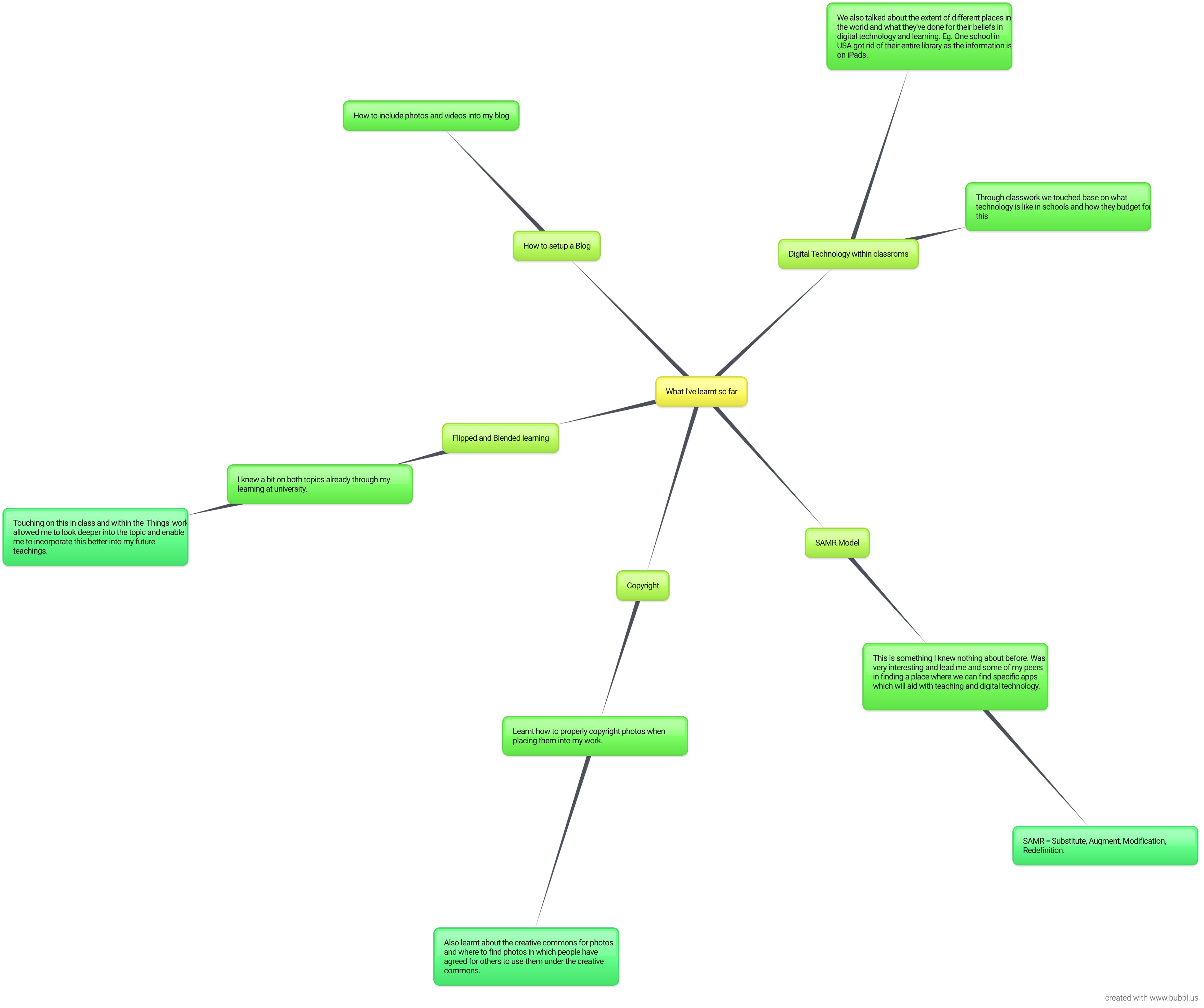
The concerns around digital technology and teaching/learning are very much valid. Although I agree with them, there is still a lot of potential with digital technologies and student learning that needs to be explored. A prime example of this would be my main research for semester one of this year, in two of my other papers, I have been exploring the potential of video gaming being used as a tool in Health and Physical Education. Again, here I found that information was scarce, but very much promising in being able to aid with learning and keep things fun and relevant.
Technology can prove to be a distraction for kids – and I’ve experienced this within schools first hand when teaching with BYOD. Kids are easily able to do what they want and switch back to the task when the teacher is around. Again, there is still potential, it’s finding a way to minimise these distractions. Technology alone can not replace good teaching, but can aid it. After all, the digital age we live in is continuing to grow, so why should we not grow with it? New ideas = New heights.

Through my first post, I outlined how I thought digital technology within the classroom was relevant – I still think this. Although now I feel as though I’m much more aware of what tools are available for offer and how to use them. Something that I think all teachers should have – more education on these tools and how to use them.
What good is all the information out there if we know nothing about it or how to use it?

Teaching is forever changing, as are the students in front of us. We need to adapt and be better. Keep learning and keep growing. Let’s change lives!

-Billie Lal
Thing 11

Connections and being a connected teacher. This is something I hadn’t given much thought to or realised the importance of. Being an educator, it’s important to be connected to others, whether its peers, friends, family, students and their families as well as the outside community. By being connected, we are able to receive feedback or search for new ideas – continuing our own learning journey.

My current connections include friends from primary school in Helensville as well as most of the towns community. My past teachers from Intermediate and High School. My friends I made when attending Mount Albert Grammar School. My family. My peers and friends I’ve made through the University of Auckland in my degree and outside of my degree. My friends in various professional sports teams or corporate companies and finally my friends and family from other countries.

Being connected through many different people and communities allows for different perspectives and scopes of feedback – further allowing us to get a great collective of information to better ourselves. Even being connected through various social media accounts allows for people like myself to see new ideas online or just keep up with whats going on and continue in myself being relevant – eg. New lingo, news and even cool PE teaching resources through facebook.

Thing 10

Feedback is something that is important is we ever want to improve in any aspect of life.
In terms of teaching, how could we ever become great a teacher if we continued doing the same thing over and over again without getting feedback from peers or our students. Although feedback on its own would be awesome, qualitative feedback is more what we’re looking for. Rather than a simple ‘yeah good’, we’re wanting to know why it was good? Why you enjoyed it? What could I do better next time? What would you have wished we’d touched on? Did I do a good job with teaching? How and Why? etc.

With quality feedback, we are able to better understand the why, and enhance our understanding from there and further act on what needs to be done. This is something that could be done at the reflection stage of a lesson, rather than waiting till the very end of the term or year to get quality feedback. We should grow as we go.

Attached is a quiz I made that could be used at the end of a class, topic or week.
The quiz was made with Survey Monkey and can be accessed easily through any device.
It’s short, with only 4 questions. The longer it was, the less interest I would receive.
https://www.surveymonkey.com/r/FZTNL25

Thing 9

Collaboration is when people bring ideas together or work together on something to achieve the overall task.
Digital tools such as Google Drive and Google Docs enable students to work collaboratively on assignments and with work in general – live – from anywhere in the world.

With this, I would use google drive and docs to help students use these tools within their group assignments. This gives students the opportunity to work collaboratively within their own homes and get instant feedback from their pairs. Students will be able to work together to solve problems rather than be tasked out different things to complete.
With Google Drive, Students can file share anything from resources, videos, documents etc. This again, means that if students also have busy schedules and can’t meet up, they can work together from the comfort of their own homes – which I think would be far more effective and less stressful for them. This can also be much easier for Teachers to access and observe from where ever and enable for faster feedback.

Thing 8

This part requires me to create a video. But why create a whole new video of nothing, when I have a whole library of already edited videos I’ve made from scratch – online.

Heres a link to my youtube channel – in which i’ve created videos of gameplay or vlogged my experience when being out and about. Everything has been recorded my me and edited by me, then uploaded by me. With this – I feel as though I’m very much capable of creating content – especially video.

http://www.youtube.com/YeahxGrizzly

A good video to start with is a Vlog I created when I went to Armageddon Expo 2018 in Auckland, New Zealand. https://www.youtube.com/watch?v=HKRHd5lOo04&t=1242s

Thing 7

Edpuzzle allows you to search for videos that are already on the net. You can duplicate the video and save it. You can then crop the video, add a voice-over, audio notes and even questions/quizzes. Edpuzzle gives flexibility to the teacher and means they dont have to create a whole new video from scratch!

The link to Edpuzzle: http://www.edpuzzle.com

I would be more driven in using ‘video’ within my teaching when teaching a new topic, as it would be a good way to let students visually see the information and process this in their own time. Students could visually process information with this tool and later come together and collaborate as a class to better understand the topic.

Thing 5

The SAMR model is an acronym for four categories. These categories include; substitute, augment, modify, and refine.
To ‘Substitute’, teachers must change from the traditional style of teaching and using a pen and paper, creating the same content on programs such as powerpoint.
To ‘Augment’, is to enhance content by using different apps, incorporating pictures brings life and allows an improvement to the students work.
By ‘Modifying’ the students will be able to change the type of content from simply writing things down to things that are accessible through digital technology. For example an video.
To ‘Refine’ a lesson is to completely transform the lesson so that it is not possible without digital technology.

Kathy Schrock’s guide to everything has a bunch of apps easily compiled. It’s really easy to navigate and has all the best apps for learning, collaboration, video editing and organising – plus more information with relation to the SAMR model.
A link to her page for further information is here http://www.schrockguide.net/bloomin-apps.html

There are a number of ways I would incorporate this within my classroom. Many resources, such as video, allows for students to film and analyse different physical activities which could be slowed down and further dissected for learning. With apps allowing students to annotate or voice over allows for them to create new pieces of work which are creative and enhance learning through greater engagement. Kathy’s website with the list of apps is something that would be very useful when finding something suitable for your topic or activity.

Thing 4

As society is constantly changing, teachers need to continue to keep their lessons relevant and interesting by teaching with different methods and sometimes even giving the students a little bit of control. This could be done through flipped and blended learning, allowing students to learn together through different resources.

I really enjoyed the topic of Blended Learning, as it allows for students to be able to learn in the traditional face to face way with the teacher and the content – as well as learning through digital technologies in and out of the classroom. A real world example of this could include the resource of facebook classrooms that teachers have began using. This allows for them to give instant feedback and upload files and resources for students to interact with. This also allows for group work/group assignments etc. This is a good way for students to interact with content as it is relevant with todays digital age and aids in defeating boredom.

The ‘Flipped Classroom’ approach allows for students to interact with information before dissecting the information within the classroom. I think this is a sound pedagogical approach to student learning as it allows for students to learn at their own pace. It is more efficient as it allows for students to come to the classroom better prepared to interact with the topic. Flipped learning also enhancing the students as more time is able to be spent on group work etc. This further enables students to work on homework or other tasks with others and can aid with advanced and less advanced students in their learning.

I think both Flipped and Blended learning are really good ways of switching up learning within the classroom. Switching between the two would enable for a much more interesting learning environment and enable students to feel as though they have some control over their learning.

Thing 3

CrossFit
Source: “CrossFit” by Flikr.com – under the Creative Common License.
Image retrieved from: https://www.flickr.com/photos/34818229@N07/8438355705/in/photolist-dREMat-pDvWnt-dRER2g-e8c2oU-dREMx6-dREXuF-dRELD4-b8tBzt-dREPM6-KRZt1-dT3hUJ-fDmNpy-37eCtY-aBMzeQ-UELyWk-fxUt5h-25QTmNQ-f6qCaC-f6boZT-f6bpsn-dShCBm-dShypW-25bekjv-4jHk9E-87MJyr-fDmMG1-6rFujN-seKzAG-vTuShy-dShoxW-87QWYw-6ffJvV-dq3xKJ-87MJsk-8vQRhK-e3kheQ-KS1zE-YpF7Qj-4NZCnn-6T5ai9-25QTn6U-6fk33w-yS8aTM-6ffV8t-6T17Mt-6ffufV-dSbZMp-dSbXer-dSbSTe-dShKmy